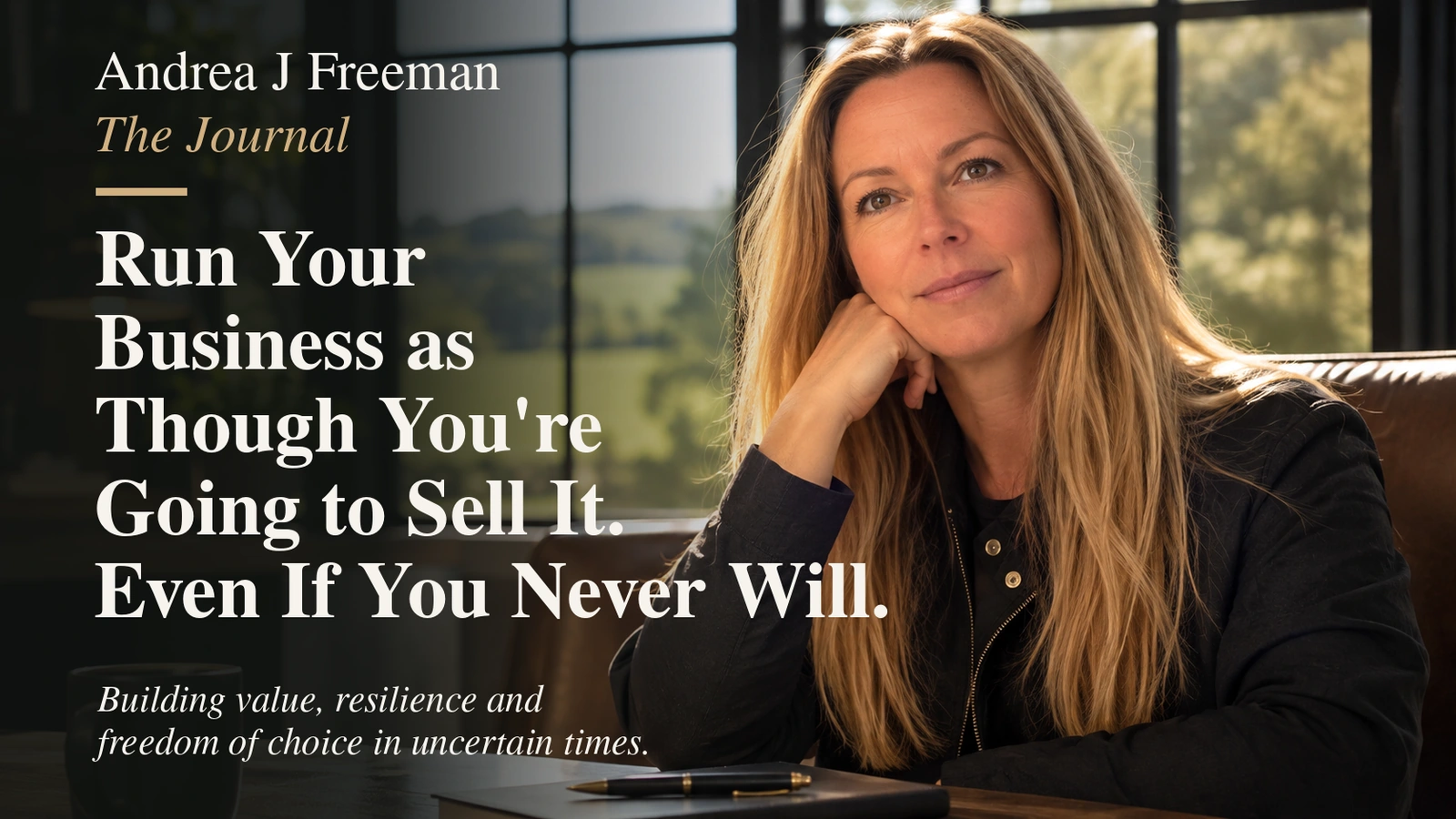
Run Your Business as Though You’re Going to Sell It. Even If You Never Will.
In uncertain times, the most valuable business strategy may be to build an enterprise that someone else would want to own.
There is a peculiar contradiction playing out in many privately owned businesses. Faced with political uncertainty, shifting tax policy, geopolitical disruption and unpredictable economic conditions, owners are becoming increasingly cautious about committing capital. Investment decisions are postponed, succession conversations become more complicated and strategic plans are quietly pushed into another financial year, when perhaps the outlook will be clearer.
The instinct is understandable. For family-owned businesses in particular, where commercial decisions are often inseparable from personal wealth, inheritance and the ambitions of the next generation, the consequences of getting something wrong can extend far beyond the balance sheet.
But there is a question worth asking. What if the greatest risk isn’t making the wrong investment, but allowing uncertainty to become the reason for making no meaningful decisions at all?
Markets rarely provide the perfect conditions for confident planning. Governments change, fiscal policy evolves and economic forecasts have an unfortunate habit of being revised. Waiting for certainty can become a surprisingly comfortable form of strategic paralysis, particularly when the business is profitable enough to continue operating without confronting its underlying weaknesses.
And while the owners wait, the enterprise itself may be becoming less valuable.
The difference between owning a business and building an asset
Many successful businesses have grown around the knowledge, relationships and instincts of their founders. Decisions are made quickly because the owner understands the customers, knows the suppliers and has spent years developing an intuitive feel for what works. The business may be profitable, respected and commercially successful, yet much of its value remains concentrated in the individual who built it.
That arrangement can work remarkably well for a long time. The difficulty becomes apparent when circumstances change.
Perhaps the founder wants to reduce their involvement. Perhaps the next generation has different ambitions. A potential investor asks questions that the management team struggles to answer independently. Or an unexpected event reveals just how many important decisions still depend on one person’s judgment.
At that point, the distinction between a successful owner-operated business and a valuable, transferable enterprise becomes painfully clear.
A prospective buyer would want to understand whether the business could continue performing without its current owner. They would examine the reliability of earnings, the concentration of customer relationships, the quality of management information and the strength of the leadership team. They would look at how decisions are made, whether processes are repeatable and where operational or commercial risks are concentrated.
These are not merely questions for a future transaction. They are questions every owner should be asking while the business is still firmly in their hands.
Because the disciplines that make a business attractive to a buyer are often the same disciplines that make it better to own.
The commercial value of being ready
Running a business as though it might be sold does not mean placing a sale sign over the door. It means making the enterprise capable of standing on its own commercial merits.
That begins with understanding where value is actually created. Which products generate sustainable contribution? Which customers are profitable once the full cost of serving them is considered? Where is working capital tied up unnecessarily, and which activities consume management attention without producing an adequate return?
It also requires greater clarity about how the business operates. Processes that depend on unwritten knowledge or constant intervention from the owner may feel efficient because they are familiar, but they create fragility. A business that cannot explain how it delivers its results will struggle to improve those results consistently.
For family businesses, this can be particularly uncomfortable. Long-standing relationships, established ways of working and responsibilities that have evolved over decades do not always fit neatly into formal structures. There may be understandable reluctance to challenge arrangements that have served the business and the family well.
Yet professionalising the organisation need not mean stripping away its character. The relationships, craftsmanship, values and entrepreneurial judgment that distinguish a family business may be among its most important assets. The objective is to make those strengths more durable, rather than leaving them dependent on the continued involvement of a handful of individuals.
Clear accountability, useful management information, disciplined investment decisions and a leadership team capable of delivering agreed outcomes do not make a business less entrepreneurial. They give entrepreneurial ambition a stronger foundation.
Why doing nothing is rarely neutral
When the external environment becomes difficult to predict, businesses often respond by preserving cash and restricting discretionary investment. There are circumstances in which that is entirely appropriate. Financial resilience matters, and an organisation that commits capital without understanding its exposure can quickly find itself in trouble.
The danger lies in treating every investment as though it carries the same risk.
There is a substantial difference between an ambitious expansion that depends on optimistic demand forecasts and an investment that improves the underlying quality of the enterprise. Better commercial information, leaner operating processes, stronger customer retention, more effective product prioritisation and reduced dependence on the founder can create value even when the wider market remains uncertain.
Some improvements require capital. Others demand something that can be harder to secure: management attention, honest conversations and the willingness to change established habits.
Consider a business that postpones investment in its management systems because the economic outlook is unclear. The decision may protect cash in the immediate term, but it also prolongs the poor visibility, inefficient processes and inconsistent information that make confident commercial decisions difficult. The very uncertainty used to justify postponement becomes harder to manage because the business has failed to strengthen its ability to respond.
The same applies to customer relationships, product portfolios and operational capabilities. A company that allows complexity to accumulate, customer concentration to increase or key knowledge to remain with a single individual may be conserving expenditure while quietly increasing its risk.
Not every investment should proceed. But every decision to defer should be examined with the same commercial rigour as the decision to spend.
The question is not simply whether the business can afford to invest. It is whether it can afford to leave a particular weakness unresolved.
A different conversation about succession
For owners of family businesses, succession is often treated as an event somewhere in the future. It might involve the next generation, a management buyout, an external sale or a gradual withdrawal from day-to-day leadership. The possibilities are considered, sometimes discussed and frequently deferred because no immediate decision is required.
But succession is not only a question of ownership. It is a question of whether the business has developed the capabilities to sustain itself through a change in leadership.
An enterprise that relies heavily on its founder may have limited options when the time comes. A business with a capable management team, transparent commercial performance, strong customer relationships and disciplined operations gives its owners considerably more freedom.
They may choose to sell. They may transfer ownership within the family. They may appoint independent leadership while retaining the business. They may decide to continue exactly as they are, but with less operational dependence on themselves.
The important distinction is that these become genuine choices rather than decisions forced by circumstances.
Tax and inheritance considerations will influence the financial consequences of those choices, and specialist advice is essential. Yet no tax strategy can compensate indefinitely for a business whose underlying commercial value is deteriorating.
The most constructive response to uncertainty is therefore not to predict every possible policy change. It is to create an enterprise with the strength and flexibility to accommodate different outcomes.
Build the business you would want to buy
Imagine looking at your own business through the eyes of a prospective buyer, without the emotional attachment, the history or the reassuring familiarity of how things have always been done.
Would you be comfortable with the quality of its earnings? Would its customer relationships survive a change in leadership? Could the management team explain its commercial priorities and demonstrate how investment decisions translate into returns? Are its processes sufficiently robust to support growth without simply adding more people, more complexity and more cost?
Perhaps most revealingly, would you be confident that the business could perform without you?
These questions are not intended to make owners defensive. They offer a useful way to separate the enduring commercial value of an enterprise from the personal effort required to keep it functioning.
They also create a shared focus for the leadership team. Instead of debating growth, cost reduction and operational improvement as separate initiatives, the organisation can examine how each contributes to a stronger, more valuable business. Decisions become easier to prioritise when everyone understands the outcomes being pursued.
That is not an argument for perpetual cost-cutting or the relentless pursuit of a higher valuation. A business can be financially efficient and strategically impoverished. It can also invest heavily in growth without creating proportionate value. The discipline lies in understanding which activities strengthen the enterprise and which merely sustain its current level of activity.
In an uncertain political and economic environment, that distinction becomes more important, not less.
You may never want to sell your business. You may intend to pass it to the next generation, retain it for decades or simply enjoy the freedom that successful ownership can provide.
But building a business that someone else would be willing to buy, on terms you would be proud to accept, is a useful measure of the quality of what you own.
Because the real objective isn’t necessarily to prepare for an exit. It’s to create a business with enough value, resilience and independence that the choice remains yours.
A private introduction
Let’s start a conversation.
Tell me a little about what’s happening in your business and where you think I might help.
A few questions will help us make a useful start. At the end, send your introduction securely and choose how you would like us to continue.
No lengthy brief. No sales team. Just a direct conversation.
Your draft stays in this conversation until you choose to submit it. Your enquiry will then be saved and emailed directly to Andrea. Any WhatsApp message still needs you to press Send in WhatsApp.
How did you find me?
It’s always interesting to know how our paths crossed.
Which business are we talking about?
I like to understand a little about the businesses I’m speaking with before we connect.
Pre-launch or no website yet? You can leave this blank.
What’s happening in your business?
A sentence or two is plenty. No confidential details needed at this stage.
Where do you think I could help?
Choose the closest fit. We can work out the detail together.
What would be useful to achieve, and when?
What would a good outcome look like for you?
A conversation with Andrea
Your introduction is ready.
Here’s what I’ll receive. Review your details and introduction before sending it securely.
- Business
- Website
- Your role
Choose how you’d like to connect with Andrea. Either way, she’ll receive your introduction immediately.
Your saved enquiry will include your contact and business details, preferred way to continue, answers and this introduction. By submitting your introduction, you are asking Andrea to use these details to respond to your enquiry. Read the privacy notice.
Preparing secure submission…
Your introduction has been received.
Andrea will be in touch shortly.
Thank you for sharing a little about your business. Your introduction has been sent directly to Andrea.
Your enquiry is already saved for Andrea. WhatsApp will open with your introduction ready. You must press Send in WhatsApp to begin the direct conversation.